Sunday, 7 April 2019

Review: The Island

The Island The Island by Ragnar Jónasson
My rating: 3 of 5 stars

Perhaps I would have benefitted from reading the first in this series of Icelandic thrillers but possibly not, as they appear to be published in reverse chronological order which in itself is an interesting concept. The Island concerns the death of one of a group of friends on an island south of the Icelandic main island, exactly ten years after the murder of another of their number. This second death is investigated by Hulda Hermannsdóttir, a somewhat tragic detective, previously passed over for promotion in favour of a seemingly less talented colleague, partially due to his successful closure of the first case. Hulda is an interesting character and the Icelandic landscape, particularly the island itself, is atmospheric and haunting. The plot, however, is a little too straightforward yet Hulda makes progress by chance rather than through her investigative skills. That said, it is perhaps her downbeat doggedness that makes her interesting and I will read the other books in the series.

View all my reviews

Saturday, 23 March 2019

Review: Uncommon People: The Rise and Fall of the Rock Stars 1955-1994

Uncommon People: The Rise and Fall of the Rock Stars 1955-1994 Uncommon People: The Rise and Fall of the Rock Stars 1955-1994 by David Hepworth
My rating: 3 of 5 stars

More a collection of articles than a cohesive narrative, Uncommon People is well-written and entertaining but lacks the singular focus of his previous book 1971 - Never A Dull Moment.

In truth, the book could have cut off at the end of the '70s, there being many, many more 'Rock Star' stories from rock & roll's first quarter century than thereafter and Hepworth's approach of one essay per year means that interest tails off towards the end. That said, his piece on Prince, which really hangs on the allegations against Michael Jackson, makes interesting reading in light of the recent Jackson documentary, and his piece on Kurt Cobain is one of the best examinations of the inability to deal with fame that I have ever read.

View all my reviews

Sunday, 3 March 2019

Review: The Scholar

The Scholar The Scholar by Dervla McTiernan
My rating: 5 of 5 stars

Dervla McTiernan’s ‘The Scholar’ builds on the promise of her first novel ‘The Ruin’. Garda Cormac O’Reilly, still viewed with suspicion by some of his colleagues in Galway, has something of a supporter in Carrie O’Halloran who recognises that Cormac’s talents are being wasted on cold cases and sees an opportunity to share some of her workload. But, as O’Reilly familiarises himself with the investigation into a man who appears to have tried to murder his wife and children, he takes a frantic call from his girlfriend, Emma, who has found a body in the road outside the university in which she works, the body of a young woman carrying the ID of the granddaughter of one of Galway’s richest businessmen.
The plot is suitably serpentine, the pace intense, but it is the cast of characters that make this such a joy to read. The key players are well-drawn, not just Cormac O’Reilly, but also Emma Sweeney, Carrie O’Halloran, Peter Fisher - these are ‘real’ people, not clichés; there are no rogue cops with drink problems here. The dialogue is realistic and we see the investigation processes at work, but ‘The Scholar’ is so much more than just a good police procedural. The suspense is extreme at times and the book is never less than satisfying. And, along the way, McTiernan asks questions about the ‘profits at all costs’ nature of Big Pharma.
I am so glad that ‘The Ruin’ was not a one-off and look forward to the next in the series.

View all my reviews

Thursday, 28 February 2019

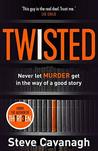
Review: Twisted

Twisted Twisted by Steve Cavanagh
My rating: 4 of 5 stars

“Who is J. T. LeBeau?”
A few years back there was a television series called ‘Harper’s Island’ which essentially took ‘And Then There Were None/Ten Little Indians’ and slasher movies and ramped up the intensity until it almost, but, importantly, not quite, became parody. It was great fun. In ‘Twisted’, Steve Cavanagh has done the same thing for the current trend for ‘this novel has a twist you will not believe’ books.
J. T. LeBeau is the blockbuster thriller version of J. D. Salinger. His novels fly off the shelves, constantly at the top of the bestseller lists and yet nobody knows who he is, not even his publisher. Except, that’s not quite right. Four people know who he is and two of them are dead… When Maria Cooper and her lover discover that Maria’s husband has $20 Million dollars in a hidden bank account, she suspects that her spouse is in fact J. T. LeBeau. And she wants her share of that money.
Cavanagh piles twist upon twist, poking fun at publishers’ need to SELL THE TWIST, while doing what a lot of the popular ‘twist’ books forget to – telling a compelling and exciting story. Yes, it veers close to spoof at times but, crucially, Steve Cavanagh expertly keeps it, just, on the side of believability and keeps the thrills, well, thrilling.
‘Twisted’ is great fun and I’m sure it will be a huge hit. And perhaps the producers of ‘Harper’s Island’ should give it a read…


View all my reviews

Wednesday, 20 February 2019

Review: The Wych Elm

The Witch Elm The Witch Elm by Tana French
My rating: 5 of 5 stars

A new Tana French novel is the highlight of my reading year. ‘The Wych Elm’ is a departure from her Dublin Murder Squad crime novels in the sense that the story is told from the perspective of the victim of the crime rather than the investigators but, like that series, is a character-driven story which really gets into the psyche of the protagonist.
When we meet Toby he is on a night out with his friends, middle-class Dublin rugby types, apparently fairly harmless, if slightly unlikeable, slightly full of themselves. But, when Toby confronts burglars at his apartment that night, he suffers head injuries and memory loss in a vicious assault. Returning to The Ivy House, his uncle’s home at which he spent a lot of his childhood, Toby’s convalescence is, at first, bolstered by helping his uncle cope with his own, terminal, illness. The two support each other and fall into an easy routine, aided by Toby’s girlfriend, and, through conversations with the cousins with whom he grew up, Toby tries to regain the memories he has lost.
Tana French is a master at these familial relationships, the small interactions, the petty jealousies and misunderstandings between people who ‘love’ each other. Toby is an unreliable narrator, all the more so because of his brain trauma, but there is a sense that each of the characters is hiding something or, at least, reframing their own narratives, editing their own stories. Then the discovery of human remains in the hollow trunk of the ancient Wych Elm tree in the back garden of The Ivy House starts Toby on a path of investigation, casting suspicion on his cousins, his uncle, even himself. As the police tear apart the garden so Toby’s questions open up old wounds, gradually unravelling first his relationships, then his self-image, his sense of who he is.
‘The Wych Elm’ is a story of psychological disintegration told with Tana French’s keen ear for dialogue and ability to get inside the minds of her characters. It is a slower novel than the Dublin Murder Squad books but no less compelling. I enjoyed it and thank Penguin Random House and NetGalley for the early access.

View all my reviews

Thursday, 7 February 2019

Review: The Wolf and the Watchman

The Wolf and the Watchman The Wolf and the Watchman by Niklas Natt och Dag
My rating: 4 of 5 stars

A dark and disturbing, very well-written and translated, novel set in late 18th Century Stockholm. King Gustav has been assassinated, paranoia is rife and, as the Revolution tears Paris apart, Sweden fears that the violence will spread from France. Against this background a city watchman pulls a body from the fetid lake, a corpse that has had his limbs amputated and his eyes and teeth removed. The watchman, Mickel Cardell, a one-armed veteran of Gustav’s ill-fated war with Russia, is thrown together with Cecil Wings, an investigator who is slowly dying from consumption, in a race to identify the mutilated man and bring his murderer to justice. This may not sound pleasant, and it is not, it is harrowing but also haunting and absorbing. The mismatched investigators are compelling characters and the first section of the book is as good a procedural as I have read recently, albeit a very unusual one.
The novel is however, split into four sections. The second section takes the form of a series of letters as a young dandy chronicles his descent into poverty and squalor. The third section tells the story of a young woman, Anna Stina, mistreated and unfairly condemned to a workhouse prison. These middle sections of the novel are almost as gripping as the main story but, for me, they broke up the rhythm of the plot. The stories are intrinsically linked to the central one but I would have preferred to have had them as more regularly interspersed subplots rather than as distinct, separate ‘parts’.
I knew next to nothing about this period of Swedish history but Niklas Natt och Dag brings the period to life, the sights and smells, the trauma and atrocities. There is a description of a naval battle that is as vivid and frightening as anything I have read on the subject. So, while I have problems with the structure of the novel, its power is unavoidable. It will stay with me for a long time and I thank NetGalley and John Murray Books for the opportunity to read it.

View all my reviews

Thursday, 31 January 2019

Review: The Last

The Last The Last by Hanna Jameson
My rating: 5 of 5 stars

“Nadia once told me that she was kept awake at night by the idea that she would read about the end of the world on a phone notification. It wasn’t exactly Kennedy’s Sword of Damocles speech, but I remember that moment word for word.
“For me, three days ago, it happened over a complimentary breakfast.”

‘The Last’
by Hanna Jameson is an End of the World novel but a thoroughly 21st Century take on the Apocalypse. Conference attendees at a secluded countryside hotel south of Zurich watch their phone screens in horror as World War III erupts. The world’s capital cities fall one by one on social media. Online footage showing the vaporisation of London “didn’t seem as real as the headlines” seeming “too fast, and too quiet.” And then, almost worse than the end of the world, the internet goes down…
The story that follows is told in the diary of Dr. Jon Keller, an American lecturer, who chronicles his and his fellow guests’ reactions to the limited news they have, to the strange coloured clouds, the lack of rain, of sunlight, to the fear of radiation poisoning. Some cannot cope and commit suicide; others deal with practicalities, rationing fuel and resources, finding food, burying the dead. And then, when the water runs cloudy and tastes off, an exploration of the water tanks on the roof reveals a dead body, a murder that occurred in the days leading up to the nuclear war.
‘The Last’ is an exciting and original novel told in a very compelling and naturalistic way. The journal form is perfect for a narrative in which the protagonist literally has no knowledge of the state of the world outside the remote hotel location. This is not a big apocalyptic novel, it is a small scale story of survival of people coping with the unknown.

‘…No one panicked, we didn’t go all Lord of the Flies. It could be fine.’

Of course, as the survivors eventually have to venture outside the hotel, we suspect that it will not be fine. The rhythm of Keller’s journal entries changes as key events occur. We go from a series of short daily entries commenting on his depression and then boredom to longer, frantic passages bringing us up to date with major events which have happened in extended periods during which Keller has been away from his book.
I loved this novel. I loved the concept when I heard about it on ‘Two Crime Writer’s…’ podcast. I have never read Hanna Jameson before and, while I understand this book is something of a departure for her, I really like the way she writes and will have added her previous books to my TBR list.

View all my reviews

Tuesday, 29 January 2019

Review: The Silent Patient

The Silent Patient The Silent Patient by Alex Michaelides
My rating: 5 of 5 stars

“As you will see, it’s an incredible story - of that there is no doubt. Whether you believe it or not is up to you.”

Theo Faber is a psychotherapist who develops an intense interest in, if not an obsession with, the case of Alicia Berenson, a relatively famous artist who, having murdered her husband has refused to speak a word and has been confined to a secure psychiatric unit in London. Despite the clinic’s shaky financial viability, Faber sets his sights on, and succeeds in gaining, a position there purely for the opportunity to treat Alicia and, in the process, perhaps persuade her to speak and reveal the truth about why she shot and killed the husband whom she appeared to love.

Alex Michaelides has written a very competent, entertaining mystery. The short chapters propel the story along with the added technique in which the last line of one chapter feeds straight into the first of the next, often contradictorily. “‘She won’t like it one bit.’” … “‘I think it’s a great idea.’” The author uses this sparingly but enough that it makes you smile when it happens and anticipate the next one. The book begins with extracts from Alicia’s diary and these reappear at stages to break up Theo’s narrative and reveal elements of her past and of her state of mind leading up to the murder. And then there is a twist.

I’m not a huge fan of ‘the twist’. There is a vogue at the moment to elevate ‘the twist’, to make it the reason to read a novel. And often it is contrived and disappointing. However, when the moment arrives in ‘The Silent Patient’ it is so unexpected and so well done that it makes the reader question everything that has gone before. I stopped and re-read the chapter. And then I read it again. I took a moment before moving on to the conclusion of the story. It is excellent and turns a good, competent mystery into a five-star thriller. The key to this is that Michaelides has laid the groundwork - the climax arises naturally from the plot, and it rings true. It is like the camera changes and you see what has gone before through a different lens. And, crucially, it makes you want to go back and read it again.

I enjoyed this a lot and it deserves to sell and to be talked about. I look forward to what comes next from Alex Michaelides.


View all my reviews

Monday, 21 January 2019

Review: Gone by Midnight

Gone by Midnight Gone by Midnight by Candice Fox
My rating: 5 of 5 stars

While I enjoyed Candice Fox’s ‘Redemption Point’, her second novel featuring Queensland PIs, Ted Conkaffey and Amanda Pharrell, I struggled to relate to Conkaffey, his every action informed by a false accusation of child abduction to the extent that it slowed the plot. Conversely, Amanda, convicted of a murder she did commit, albeit accidentally, was a whirling dervish, a ball of energy with no social graces who offended all around her while displaying almost Holmesian deductive skills.
‘Gone By Midnight’, the third in the series, is a tighter novel, fast-moving and with fewer flaws. Ted Conkaffey, perhaps due to the presence of his infant daughter who is staying with him for the first time since his fall from grace caused the breakup of his marriage, is a much more sympathetic character. His anger, and shame, at those who still suspect him despite his no longer being a ‘person of interest’, and his love for his daughter, drives him as he and Amanda try to locate an eight-year-old boy who has disappeared from a local hotel.
Amanda remains a thoroughly entertaining character. She ‘hates’ children, shows little empathy for the missing boy or his parents, sees the boy’s disappearance as a competition the winner of which is rewarded with a cake, and makes friends with a criminal biker gang while making enemies within the police force.
‘Gone By Midnight’ is a more complete and confident novel than ‘Redemption Point’. The mystery is intriguing and entertaining, the characters more fully realised, the dialogue sharp and I look forward to the next in the series.

View all my reviews

Friday, 18 January 2019

The Hunting PartyThe Hunting Party by Lucy Foley
My rating: 4 of 5 stars

Lucy Foley’s “The Hunting Party” is an excellent claustrophobic psychological thriller that questions how well people really know each other.
Nine entitled friends travel to the Scottish Highlands for a New Year’s Celebration where a tragedy occurs. The story is told in two timelines, events leading up to the disappearance of one of the guests, narrated in the first person by three of the female guests, and the aftermath, again in the first person, by the female caretaker of the Highland Lodge. At intervals, we also learn, in a third person narrative, about the estate’s gamekeeper, a man with a hidden past.
The story is full of red-herrings and misdirection and the author cleverly hides the identity, and even the gender, of the missing guest, a technique that is only very rarely apparent to the reader - there were a couple of occasions where I thought, “wouldn’t it have been more natural for the character to say the name”, but they were few and far between and did not spoil my enjoyment of the story.
There are few, if any, likeable characters in the novel and even the best of them have some darkness in their past that affects their actions but that is not a criticism - they all rang true, and it is fun to piece together what is really behind the unreliable narrators. Apparently optioned for TV, the story would make an excellent miniseries.


View all my reviews

Wednesday, 9 January 2019

Review: The Chestnut Man

The Chestnut Man The Chestnut Man by Søren Sveistrup
My rating: 5 of 5 stars

While I have enjoyed a lot of what could be termed ‘Scandinavian Noir’ I have always found the television from the Nordic countries to be more dynamic and involving than their literature. Series such as The Killing and The Bridge, despite complex plots, focus as much on the human element as on solving the crimes. Søren Sveistrup, writer of the former series has, perhaps not surprisingly, written a novel more akin to those television series than to his contemporaries on the bookshelves.
The Chestnut Man is a fast-moving crime novel. The plot, as complex and intriguing as it is, fairly thunders along. Two detectives, the young ambitious, Naia Thulin and, burnt out jaded Europol cop, Mark Hess, who has been sent back to Copenhagen while an investigation is held into possible misconduct, are initially suspicious of each other. However, as they investigate the murders of two women in separate incidents, the pair are drawn together as their theories that the crimes are connected, not only to each other but possibly to the disappearance of a senior politician’s daughter a year ago, put them out of step with their colleagues who consider the early crime solved as a murder, despite the lack of a body.
Like The Killing, The Chestnut Man is a mixture of police procedural, politics and familial relationships and it is the impact of the crimes on the families - the Government minister and her husband who are struggling with the loss of their daughter, Thulin’s distress at neglecting her own daughter because of her career ambitions - which, I feel, sets the novel apart. An entirely satisfying crime story, the book also sheds some light on another side of the Danish capital, the poorer tenements, the immigrant communities.
I enjoyed The Chestnut Man immensely and look forward to more from Søren Sveistrup, especially if he revisits Thulin and Hess.

View all my reviews

The Buffalo Hunter Hunter by Stephen Graham Jones

Etsy Beaucarne is an academic who needs to get published. So when a journal written in 1912 by Arthur Beaucarne, a Lutheran pastor and her g...